


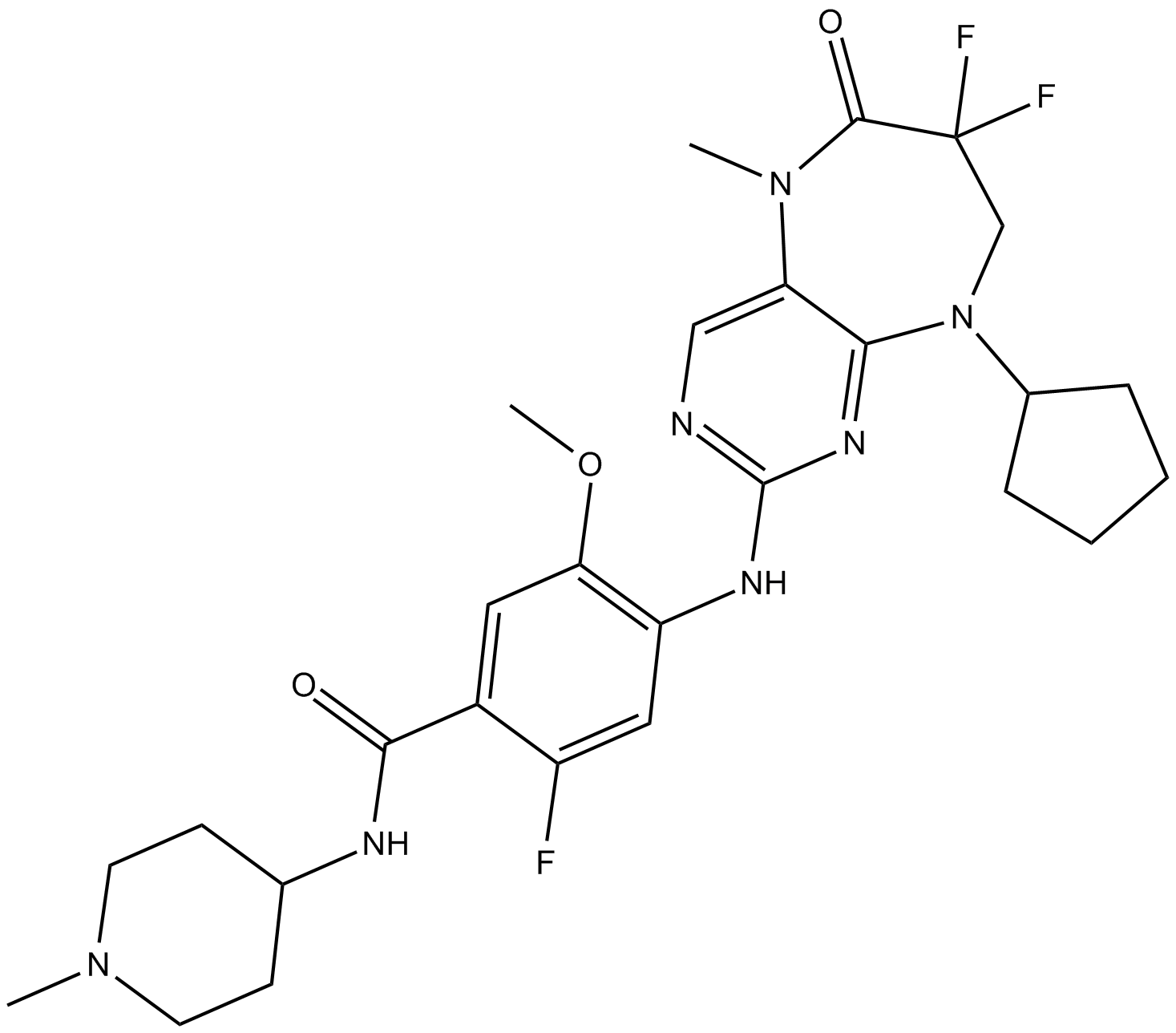
TAK960
A selective inhibitor of polo-like kinase 1
此产品仅用于科学研究,我们不为任何个人用途提供产品和服务

-
包装价格促销价数量
-
1mg¥275.00220.00- +
-
5mg¥1412.001130.00- +
-
10mg¥1962.001570.00- +
-
50mg¥5825.004660.00- +


- 货号: ajci5788
- CAS: 1137868-52-0
- 别名:
- 分子式: C27H34F3N7O3
- 分子量: 561.6
- 纯度: >98%
- 溶解度: ≥ 28.05mg/mL in DMSO
- 储存: Store at -20°C
- 库存: 现货
Background
TAK-960 is an orally available, selective inhibitor of polo-like kinase 1 (PLK1), with an IC50 of 0.8 nM at 10 μM ATP; TAK-960 also shows inhibitory activities against PLK2 and PLK3, with IC50s of 16.9 and 50.2 nM, respectively. TAK-960 inhibits full-length PLK1 protein with IC50 of 0.8 nM, wich is 20-fold lower than the next lowest IC50 value (PLK2: 16.9 nM). TAK-960 (2-1000 nM) causes accumulation of G2-M cells in HT-29 cells. TAK-960 inhibits proliferation of multiple cancer cell lines, with mean EC50 values ranging from 8.4 to 46.9 nM, but not in nondividing normal cells[1]. TAK-960 (8?nM) leads to G2/M cell cycle arrest without significant cytotoxicity in HeLa cells. TAK-960 does not sensitize cancer cells to radiation when an insufficient amount of time is provided to induce mitotic arrest. The overexpression of a PLK1 mutant, PLK1-R136G&T210D, which is confirmed to cancel the TAK-960-mediated increase in the proportion of mitotic cells, abrogates the radiosensitizing effects of TAK-960[2]. TAK-960 (7.5 mg/kg, p.o.) shows a significant increase in median survival compared with vehicle in MV4-11 human leukemia model. TAK-960 (10 mg/kg, p.o.) inhibits tumor growth in the MDR1-expressing K562ADR-bearing leukemia xenograft model[1]. TAK-960 (10?mg/kg) significantly suppresses tumor growth when combined with IR in tumor xenografts[2].Reference: [1]. Hikichi Y, et al. TAK-960, a novel, orally available, selective inhibitor of polo-like kinase 1, shows broad-spectrum preclinical antitumor activity in multiple dosing regimens. Mol Cancer Ther. 2012 Mar;11(3):700-9.
[2]. Inoue M, et al. PLK1 blockade enhances therapeutic effects of radiation by inducing cell cycle arrest at the mitotic phase. Sci Rep. 2015 Oct 27;5:15666.
Protocol
|
Kinase experiment: |
The inhibitory activity of TAK-960 is assessed by the TR-FRET (fluorescence resonance energy transfer) assay, which measures the ATP-dependent phosphorylation of a biotinylated substrate peptide corresponding to residues 2,470 through 2,488 of the mTOR protein (Biotin-AGAGTVPESIHSFIGDGLV). A total of 288 kinases are screened for TAK-960 inhibition (1 μM) using HotSpot technology and IC50 values for the selected kinases are determined. |
|
Cell experiment: |
Cells are seeded into 96-well plates at 3,000 to 30,000 cells per well in appropriate medium plus 10% fetal calf serum. After 24 hours, cells are treated with serial dilutions of TAK-960, and 72 hours later, the number of viable cells is assessed using the CellTiter-Glo Assay. Calculation of EC50 values and statistical analysis are done using GraphPad Prism software. |
|
Animal experiment: |
The suspension of HeLa cells (2×10⁶ in 100?μL PBS) or H1299 cells (3×10⁶ in 100?μL PBS) is subcutaneously inoculated into the right hind legs of 8-week-old nude mice (BALB/c nu/nu mice). The indicated dose of TAK-960 is orally administered to tumor-bearing mice. In the radiation treatment, tumor xenografts are locally irradiated with the indicated dose of 137Cs γ-rays using a Gammacell 40 Exactor. |
|
参考文献: [1]. Hikichi Y, et al. TAK-960, a novel, orally available, selective inhibitor of polo-like kinase 1, shows broad-spectrum preclinical antitumor activity in multiple dosing regimens. Mol Cancer Ther. 2012 Mar;11(3):700-9. |
|


